Twyfelfontein: Namibia's UNESCO Rock Art Treasure
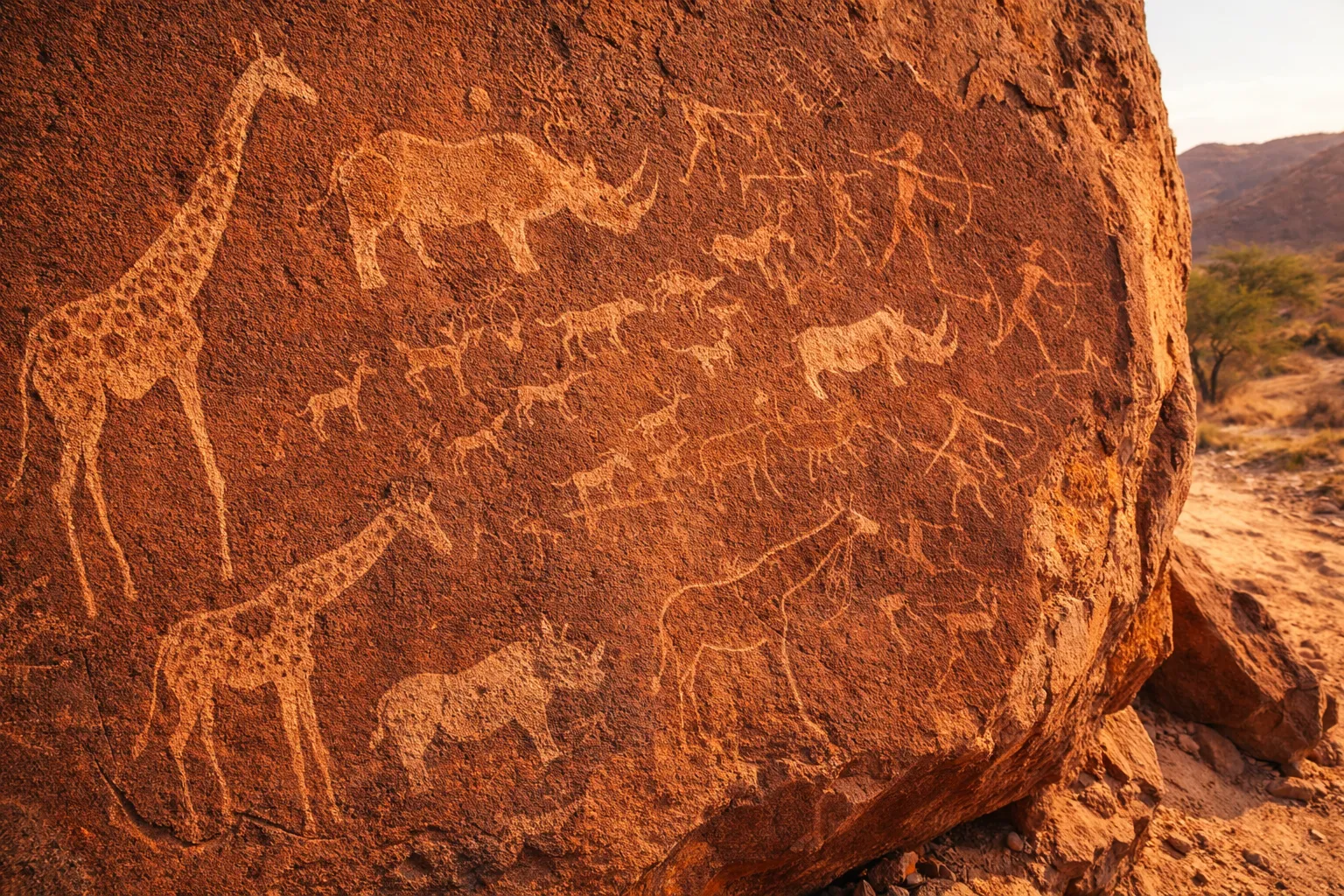
Twyfelfontein, in Namibia's Kunene Region, holds one of the largest and most significant concentrations of prehistoric rock art in Africa — an estimated 2,500 engravings spread across weathered red sandstone outcrops. In 2007, UNESCO recognised it as Namibia's first World Heritage Site.
Most of the engravings are petroglyphs — images pecked into the rock face rather than painted — and they range from relatively recent (a few thousand years old) to estimates of up to 6,000 years. Giraffes, rhinos, zebras, lions, and ostriches dominate. A handful of abstract geometric patterns are thought to have been created during altered states, linked to shamanic ritual among ancestral San populations.
Two engravings are almost universally included on every guided tour: the Lion Man, a lion depicted with five-toed human-like feet and an unusually long tail, and the Dancing Kudu, a kudu with its front legs lifted mid-stride. Both sit near the main trail loop and are the high points of most short visits.
Entrance to the site is managed through a visitor centre with mandatory guided walks — self-guided access is not permitted, both for conservation reasons and because the engravings are genuinely hard to spot without pointing out. The main short route takes about 40 minutes; a longer 90-minute loop covers more distant panels.
Early morning is the best time — both for photography (side-lighting picks out the engraved lines) and for comfort (afternoon temperatures in summer regularly exceed 38°C with no shade on the rocks). Pair the visit with the nearby Organ Pipes geological site and the Burnt Mountain viewpoint for a full half-day around Twyfelfontein.